
It’s the scenario every driver dreads: you turn the key one morning, and nothing. Not a sound, not an attempt – or worse, a sharp click followed by a heavy silence. Before you panic and call a tow truck, take two minutes to observe what’s happening. In the vast majority of cases, a no-start has an identifiable cause, often easy to diagnose right from your parking spot.
DriveBerry guides you step by step to read the signals your car is sending, understand what’s going on under the hood, and choose the right course of action – without the mechanical jargon.
Car won’t start? Identify the fault in 5 minutes

The 5 most common causes of a no-start
1. The battery is flat or failing
The battery is suspect number one. It powers all of the vehicle’s electrical systems, including the starter. A dead or weakened battery gives itself away with very telltale signs: nothing happens when you turn the key, the starter makes rapid clicking sounds without managing to crank the engine, or the lights and dashboard don’t come on. To confirm, a multimeter is enough – a healthy battery reads between 12.4 and 12.7 volts at rest. Below 12 volts, recharging or replacement is required. A battery’s average lifespan is 4 to 5 years, and winter cold speeds up its decline.
2. The fuel tank is empty
As obvious as it may seem, an empty tank is a far-from-negligible cause of reported breakdowns. The fuel gauge can sometimes be faulty, or the oversight happens after a late-night trip. Always check the gauge before exploring other leads. If filling up solves the problem, great. If the engine stays silent, then the gauge is faulty or the fuel pump isn’t drawing the fuel correctly – in which case a professional is needed.
3. The starter motor is faulty
Your headlights, stereo and dashboard work perfectly, but the engine doesn’t react – not even an attempt to turn over? The problem most likely comes from the starter motor. This small electric motor has the sole job of cranking the combustion engine at start-up. Its failure can stem from the solenoid, a fouled electric motor, or a broken fork. Diagnosis and replacement require a professional. This is exactly the type of repair for which DriveBerry directs you to a certified garage in just a few clicks.
4. The engine is flooded
If you’ve made repeated start attempts in a short time, you may have injected too much fuel into the cylinders – what’s known as flooding the engine. The excess fuel prevents combustion from occurring properly. The fix is simple: wait 20 to 30 minutes, let the surplus evaporate, then try starting again with the accelerator pedal pressed slightly. If the problem keeps recurring, an underlying mechanical part is probably faulty.
5. The spark plugs are faulty
Spark plugs play an essential role depending on the type of engine. On a petrol engine, the spark plugs create the spark that triggers combustion. On a diesel, the glow plugs heat the combustion chamber to ease cold starting. In both cases, worn or fouled plugs cause misfires at start-up, or even a complete no-start. Check your service booklet for the recommended replacement interval – generally between 30,000 and 60,000 km.
Quick diagnostic table
| Observed symptom | Probable cause | Recommended action |
|---|---|---|
| Total silence when you turn the key | Dead battery | Jump leads or charger |
| Rapid repeated clicking | Weak battery | Test the charge, recharge |
| Headlights OK but engine silent | Faulty starter motor | DriveBerry certified garage |
| Engine cranks but won't start | Spark plugs / flooded / fuel | Wait 30 min or OBD scan |
| Engine warning light on | Electronic fault | BerryScan™ DriveBerry |
Other less common causes worth knowing
If the five main causes have been ruled out and your car still refuses to start, other components may be at fault. Damaged ignition coils generate the high voltage the spark plugs need – their failure blocks starting with no obvious prior warning. A clogged diesel particulate filter (FAP), common on diesels used mainly in town, can progressively prevent the engine from running correctly. A fouled EGR valve, meanwhile, disrupts the management of recirculated gases and can lead to starting difficulties. A faulty crankshaft position sensor prevents fuel injection at the right point in the engine cycle – the result: the engine turns over but won’t start. Finally, a failed fuel pump quite simply starves the engine of fuel. These more complex diagnoses require an OBD reader tool.
How DriveBerry helps you in under 2 minutes
With DriveBerry’s AI diagnosis, describe your problem in natural language – text, photo or audio. Our engine analyses your symptoms, asks the targeted questions needed, and returns the two most likely hypotheses for your vehicle, along with a realistic price range and a list of certified garages available near you.
For electronic faults or warning lights, BerryScan™ reads the OBD error codes directly from your home (€49), or at a DriveBerry partner service station (€9.99). The codes are automatically sent to our AI for an enhanced diagnosis.
Similar articles

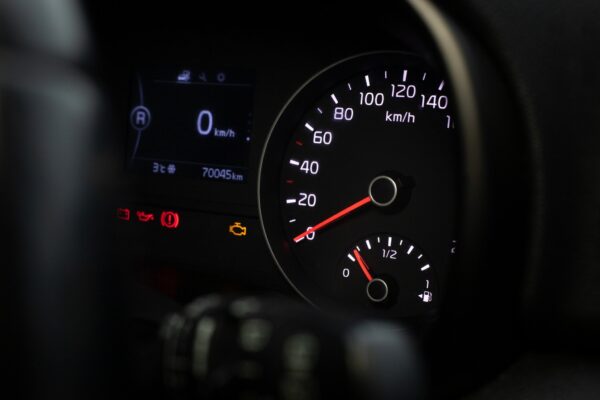
Orange engine warning light on: panic or not?
Brake pads and discs: when should you replace them?
Car diagnostics: everything you need to understand before heading to the garage